
If you have ever searched for “coffee shop near me” or “plumber in your city” on Google you have seen search engine optimization in action. For businesses showing up in those results is not because of luck. It is because of consistent and deliberate effort.
The problem with Local SEO for small businesses owners is that they think of local SEO like a switch that you can turn on and then forget about. They make a Google Business Profile add some details and think that customers will just show up.. Customers do not just show up like that. Local search engine optimization is like taking care of a garden. You have to keep working at it all the time. Local SEO For Small Businesses that keep doing things are the ones that get ranked higher than the ones that stop trying after the first little bit.
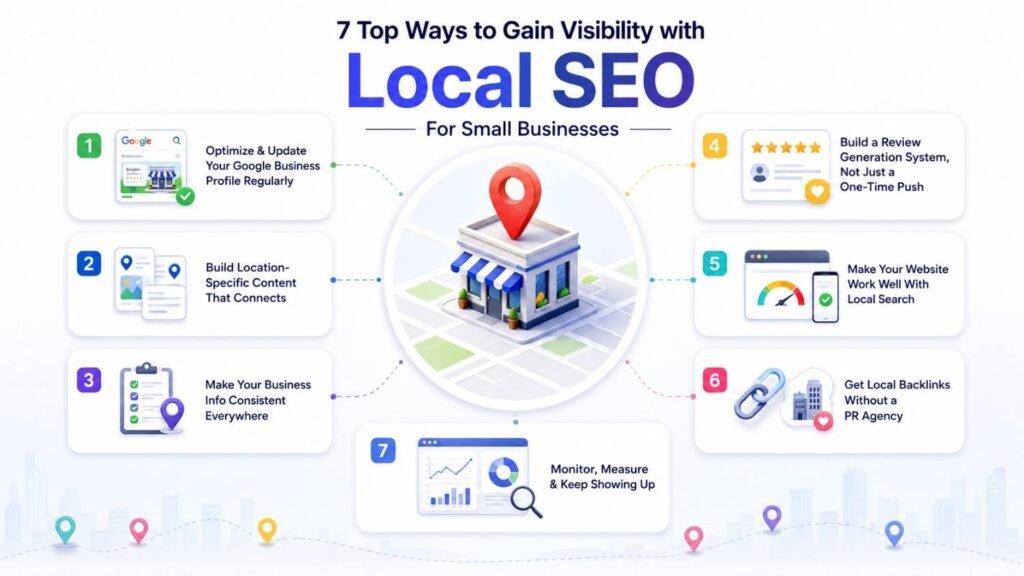
This guide will tell you, about seven ways that really work for businesses to get people to notice them in their area based on what actually works not just what people think should work.
1. Stop Treating Your Google Business Profile as a “Set It and Forget It” Task
Your Google Business Profile (GBP) is the single most important asset in local SEO. It directly influences your rankings in Google’s local pack — those three business listings that appear at the top of local search results — as well as customer trust and conversions.
When evaluating a local business’s online presence, the GBP is the first place to look. Here’s what a healthy profile looks like:
- Accurate NAP (Name, Address, Phone number) that matches your website and other directories
- Correct primary and secondary business categories — this is often misconfigured and quietly tanks rankings
- Updated business hours, including holidays
- Recent photos that show the business as it actually looks today
- Regular posts — promotions, updates, events — that signal an active, legitimate business
- Prompt responses to customer reviews, both positive and negative
Here’s the hard truth: businesses with beautifully designed websites can still lose visibility to competitors with mediocre websites but active, optimized GBP profiles. Google rewards engagement. Treat your GBP like a living storefront, not a filed form.
2. Build Location-Specific Content That Most Businesses Do Not Use
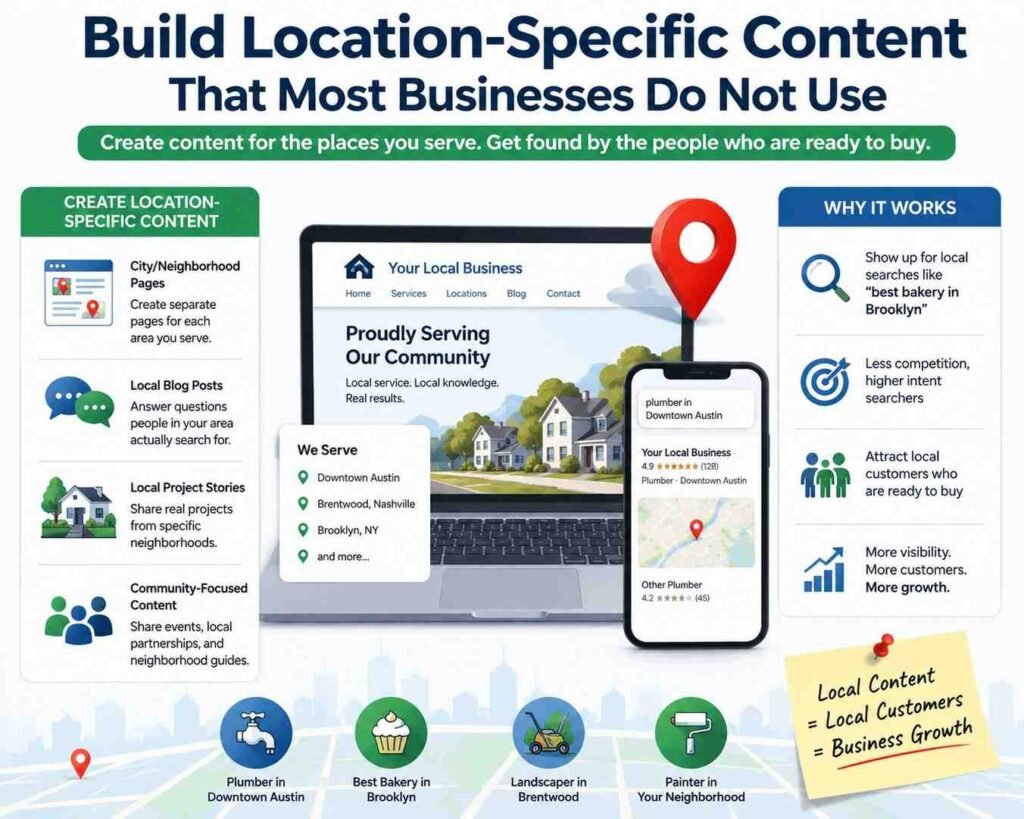
This is a way to improve Local SEO for small businesses search results but most businesses do not do this.
The average small business has a homepage, a page that lists their services and a contact page that is all they have.
They are trying to get noticed in their area without giving Google any information about where they’re located except for their address.
To fix this problem Local SEO for small businesses should create Location-Specific Content that’s specific to the areas they serve.
This can be done in ways, such as:
* Creating separate pages for each city or neighborhood they serve instead of just having one page that lists all their services.
* Writing blog posts that answer questions that people in their area might have like “What do I need to do to renovate a bathroom in Austin?” of just writing about bathroom renovations in general.
* Sharing stories about projects they have completed in areas like “How we landscaped a backyard in the Brentwood neighborhood of Nashville”.
* Creating content that is focused on the community, such as information about events, partnerships with other businesses in the area and guides to different neighborhoods.
These types of pages can help Local SEO for small businessess show up in search results for phrases like “plumber in Downtown Austin” or “best bakery in Brooklyn”.
These phrases are often less competitive, than phrases and the people who search for them are usually looking to buy something not just browsing.
Location-Specific Content can really help Local SEO for small businesses get noticed in their area.
By using Location-Specific Content small businesses can get customers. Grow their Location-Specific Content business.
Small businesses should use Location-Specific Content to get customers.
3. Make Your Business Info Consistent Everywhere
Your business name, address and phone number are super important. Search engines use them to figure out if your businesss real and where its located. If they’re not the same it can cause trouble. For example if your phone number on Yelp is different from your phone number on another website it can confuse search engines. Hurt your local search rankings.
Don’t try to make your business info perfect on every website. That’s a waste of time. Instead make a list with your business name, address, phone number, website URL and hours. Use this list on every website. Make sure your business name, address and phone number are always the same.
Here’s where to start fixing your business info:
* Google Business Profile
* Your own website
* Apple maps
* Bing Places
* Yelp
* Big directories that are specific to your industry
* Other websites that are
Focus on the websites your customers actually use. Fix those first. You won’t get all the benefits if you fix every website but you’ll get most of them if you do the important ones.
Here’s a tip: search for your business name, phone number and address on the internet. Look for listings or wrong information. Check your business info, on websites every month. Whenever you move, change your phone number or update your branding.
4. Build a Review Generation System. Not Just a One-Time Push
Customer reviews are one of the strongest ranking signals in Local SEO. They not only influence your visibility in local search results but also affect whether potential customers choose to click, call, or visit your business. If one business has 12 reviews and another has 200, the one with 200 authentic reviews will often have the advantage, even if both have similar star ratings.
Businesses that consistently earn reviews don’t leave it to chance—they build a repeatable system that encourages customers to share their experiences.
A simple review generation process looks like this:
- Deliver a great customer experience.
- Ask for a review immediately after the positive interaction.
- Provide a direct review link that’s easy to access.
- Send a friendly follow-up if the customer hasn’t responded.
- Respond thoughtfully to every review you receive.
Timing matters. The best time to ask for a review is when the customer is happiest—right after completing a job, finishing a purchase, or resolving a problem. People’s excitement fades quickly, so asking while the experience is still fresh increases the chances of getting a review. Sending a review link by text message, email, or QR code makes the process simple. In many cases, an in-person request from a staff member, such as, “We’re a small business, and reviews really help us. Would you mind sharing your experience?” can be even more effective.
Avoid offering discounts, gifts, or incentives in exchange for reviews. This violates the policies of most review platforms, including Google, and can reduce customer trust if discovered.
Finally, respond to every review. Thank customers for positive feedback, and handle negative reviews professionally without becoming defensive. Engaging with reviews shows that you value customer feedback, builds trust with future customers, and strengthens your overall Local SEO strategy by demonstrating that your business is active and responsive.
5. Make Your Website Work Well With Local Search
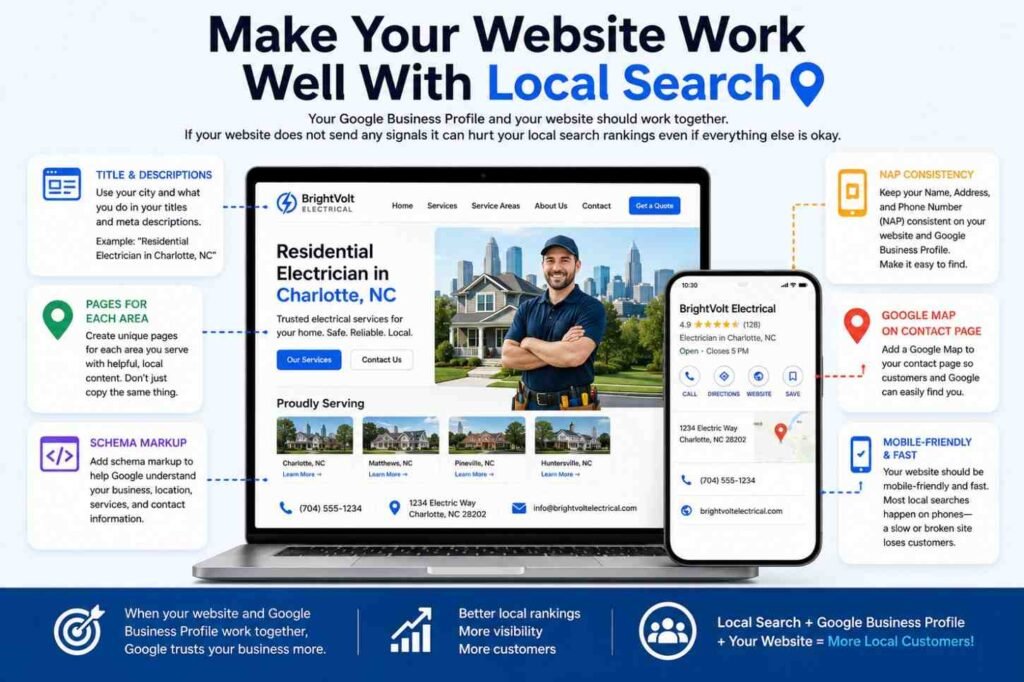
Your Google Business Profile and your website should work together. If your website does not send any signals it can hurt your local search rankings even if everything else is okay.
Here are some important things to do for search:
* Title. Descriptions that have your city and what you do in them like “Residential Electrician in Charlotte, NC”
* Pages for each area you serve with content. Do not just copy the same thing
* Special codes called schema markup that help Google know what your business is, where it is and how to contact you
* Your name, address and phone number should be the same on your website and Google Business Profile. It should be easy to find
* A map from Google on your contact page
* Your website should work well on devices and be fast. Most people use their phones to search for things locally and if your website is slow or does not work you will lose customers. Your website needs to be good, on devices because that is what people use to search for local things. Local search and Google Business Profile and your website all need to work.
6. Get Local Backlinks Without a PR Agency
Local backlinks are important because they show Google that your business is a part of the community. For your business the best backlinks do not come from publications but from local connections that you make.
Here are three simple ways to get backlinks:
* Local SEO for small businesses groups and chambers of commerce are a good place to start. Most of them have member directories with links. Google trusts these local websites.
* You can also. Join local events. When you do this event pages and community groups will often link back to your business. So will local news sites.
* Another way to get backlinks is to team up with other local SEO for small businesses. For example a wedding photographer can work with a florist or a contractor can refer a local interior designer. When you work together with local businesses you will often get natural mentions and local backlinks.
The goal is not to get a lot of backlinks. Local backlinks from trusted websites are more valuable than many low quality links from outside your area. A few local backlinks from local sources are better, than many low quality links. Local backlinks are what you need to focus on.
7. Monitor, Measure and Keep Showing Up
Businesses that do well with Local SEO for small businesses are not doing anything special. They just keep doing the basics all the time. They make search engine optimization a part of their routine not something they do once. Then forget about it. Local SEO for small businesses is something these businesses take seriously.
You can see how you are doing with search engine optimization for businesses by using:
- Google Business Profile Insights to see how many people are looking at your business and how they found you
- Google Search Console to see what people are searching for when they come to your site
- rank tracking tools to see how your business is ranked for keywords in your area
For good Local SEO for small businesses you should check your Google Business Profile every month to see what people are saying about your business and respond to any comments. You should also add information about your business. Make sure it is listed correctly in all the right places. Doing this every month will really help people find your business.Local SEO for small businesses is about being consistent and showing up all the time.
A few things to note about why this works:
- The keyword Local SEO for small businesses appears a times in this text about three times in a short paragraph, which is a natural way of using it.
- It is used in parts of the sentence so it does not sound like a machine wrote it.
- I kept the meaning of the text. Just made some small changes to make it sound better and added Local SEO for small businesses where it fit naturally.
If you want I can also give you a version with the keyword highlighted for use on a website. Suggest some keywords like local search rankings or Google Business Profile optimization to add some depth to the topic. Local search engine optimization for businesses and local search rankings can go hand in hand. Using keywords like Google Business Profile optimization can really help your business.Local SEO for small businesses is important and using the right keywords can make a big difference.
Frequently Asked Questions
How long does it take to see results from search engine optimization? Most businesses start to see results in three to six months if they keep at it with search engine optimization. It may take longer in areas. The important thing is to keep doing search engine optimization. If you only do search engine optimization sometimes you will only see results sometimes.
Is Local SEO for small businesses that do not have a store? Yes. Google lets these businesses hide their address and say what area they serve instead. The same basic ideas apply to search engine optimization. These businesses need to focus on what they say about themselves what their customers say about them and who is linking to their website because they do not have a real location that people can visit.
Is a Google Business Profile necessary for Local SEO For Small Businesses? Yes. You really need a Google Business Profile that is set up correctly. This is one of the things that helps your business show up in local search results. If you keep your Google Business Profile accurate and updated it can really help people find your business when they search on Google or use Google Maps. A good Google Business Profile is very important ,Local SEO For Small Businesses.
How Google comments do I need to rank well in my area? There is no number but businesses with a lot of good comments do better than those with old or few comments. You should try to get a stream of comments instead of trying to get a certain number of comments.
Do social media profiles help with search engine optimization? Kind of. Social media profiles help people find your business online and can show up when people search for your business. They do not directly help your business rank higher in search results like your Google Business Profile and other listings do for search engine optimization.
How can I measure the success of Local SEO For Small Businesses? You can measure success by tracking local keyword rankings, Google Business Profile insights, website traffic, phone calls, direction requests, form submissions, and the number of leads or sales generated from local search.
The Bottom Line
Local SEO is not hard to understand. You have to keep doing search engine optimization. The businesses that people can find and that stay visible are the ones that keep working at search engine optimization. They do not just do search engine optimization once. Then stop. You should start with your Google Business Profile add information about your location get comments from your customers in a way that you can repeat and make sure your business information is the online. If you do these things all the time with search engine optimization they will work better, than any shortcut.