
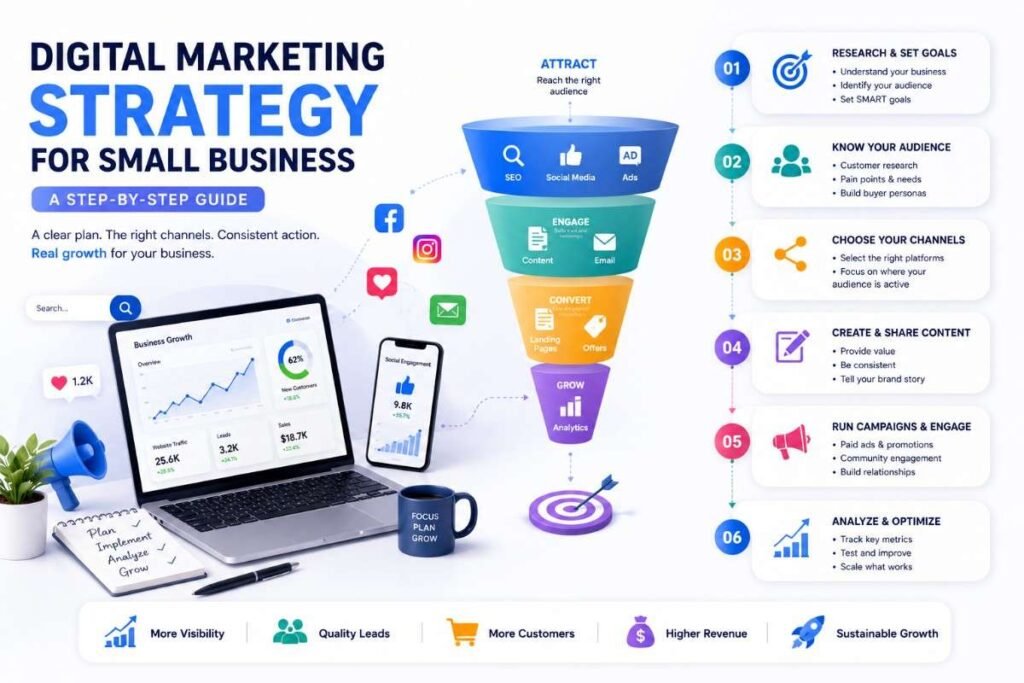
If you’ve ever felt like you’re throwing money at Facebook ads, posting randomly on Instagram, and hoping something sticks — you’re not alone. I’ve worked with dozens of local businesses, e-commerce stores, and service providers as a freelance digital marketer, and almost none of them struggled because their product or service was bad. They struggled because they never had a clear digital marketing strategy for small business — just a pile of disconnected tactics.
A good plan is not about trying to be at the same time. A good plan is about choosing the social media platforms for your goals, your audience and the money you have to spend. Then you do these things in the order. This guide will show you how to do this one step at a time using things that have actually worked in projects, with real clients and things that have not worked in real projects with real clients.
Why Most Small Businesses Struggle With Marketing (It’s Not What You Think)
I have seen that people who own businesses do not usually fail because they are not trying hard enough or they do not want to succeed. They fail because of things like this:
* They try to use marketing channels all at the same time instead of getting really good at one or two marketing channels first
* They skip the part where they check everything and just start doing marketing
* They do not set goals that they can measure so they cannot figure out what is actually working for their business
* They copy what another business is doing without understanding why it is working for that other business
The good news is that once you start using a structured Digital Marketing Strategy , for your small business most of these problems will go away on their own.
What Is a Digital Marketing Strategy for Small Business?
A business needs a marketing plan that says what the business wants to do and how it will get there. This plan uses things like SEO, social media, Google Ads, email and content to reach people. It also says when things will happen and how we will know if they are working.
For example it is better to say we will post on Instagram three times a week to get more people to visit our profile and then go to our website because that is where the people who are interested in our business already are.
People do things in a way when they are looking for a business. Usually they search online first. Almost everyone does this before they go to a business.. When they use Google, about half the time they are looking for something in their area. This is what Google and BizIQ say about how people search.
If your Digital Marketing Strategy plan does not think about how people really search and make choices your business will not do as well as it could. Your plan needs to consider Digital Marketing Strategy for business and how people use SEO, social media and Google Ads to find things. This is important for a business to have a digital marketing strategy, for business.
Step-by-Step Digital Marketing Strategy for Small Business Owners
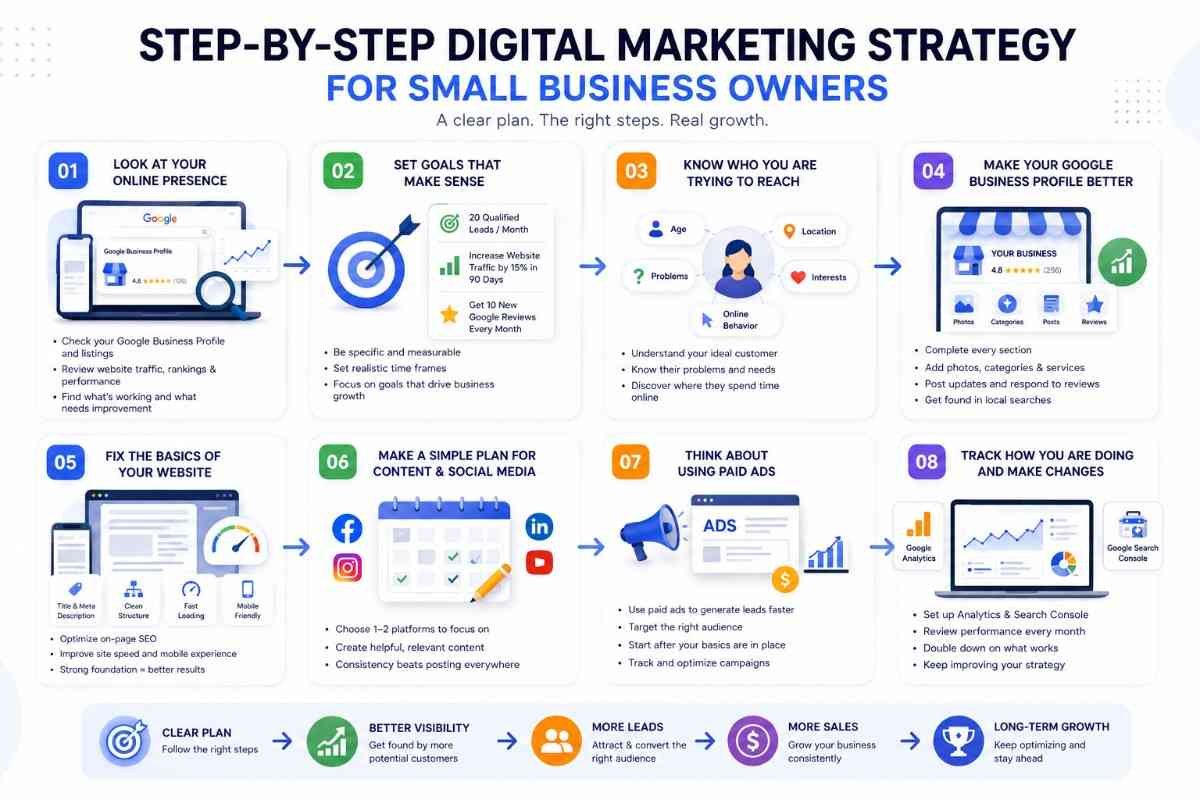
Step 1: Look At Your Online Presence
You should take a look, at your Google Business Profile and your accounts to see how your website is doing now. You need to check your Google Business Profile and see what is going on with your website. This will help you understand how your website is doing. Look at your Google Business Profile and your accounts to get an idea of what’s happening with your website right now.. This will show you where you need to improve of just guessing.
Step 2: Set Goals That Make Sense
If your goal is just to get customers that is not helpful. You need to set goals like getting 20 good leads every month or increasing the number of people visiting your website by 15 percent in 90 days or getting 10 new Google reviews every month.
Step 3: Know Who You Are Trying To Reach
You need to know who you are actually trying to talk to. How old are they, where are they from what are their problems and where do they spend time online. This will help you decide which way to go. If you skip this step you might waste your money on ads.
Step 4: Make Your Google Business Profile Better
For businesses that’re local or provide services this is a very important step. You need to make sure your Google Business Profile is complete and accurate with photos, categories and regular posts. This will help you show up when people search for something near them. Google says that businesses with profiles are more likely to get visited and considered.
Step 5: Fix The Basics Of Your Website
You need to make sure your website is working well. This includes things like the title of your page the description, how your page is set up how fast it loads. If it works well on mobile phones. This is not the exciting work but it is necessary. If you do not do this your marketing and ads will not work well.
Step 6: Make A Simple Plan For Content And Social Media
You do not need to post something every day on six platforms. Just pick one or two platforms where your audience’s try to be consistent. It is better to have a plan and stick to it than to try to post something every day.
Step 7: Think About Using Paid Ads
If your website and Google Business Profile are good you can use paid ads to get leads faster. This is especially helpful for businesses that need leads. I usually start using paid ads after the basicsre, in place so I do not waste money sending people to a website that is not ready.
Step 8: Track How You Are Doing And Make Changes
You should set up Google Analytics and Google Search Console from the start. Look at how you’re doing every month not just when something seems wrong. Your plan is never really finished you need to keep making it better based on what’s working and what is not.
Real Client Example: Turning Around a Local Service Business
Within a months the website traffic for the business went up they got better rankings for the main keywords for their services and they started getting a lot of good leads from the website and Google Business Profile. This was a change from before when they were relying only on referrals. I want to be honest with you the results can be different for each business because it depends on the type of industry the competition and where they started. So I do not want to promise that every business will get the results.
One of my clients did not have a plan for digital marketing strategy they just had an old website and they had not even claimed their Google Business Profile. I started by checking everything then I made their Google Business Profile better I fixed the problems with the website. I made a simple plan, for content and social media that was based on what they actually did. The way I did it. Checking everything then doing SEO fixing the website and then making content. Is something that has worked for many of my clients.
Common Mistakes Small Business Owners Make With Digital Marketing
- Trying everything at once — spreading a small budget across five channels instead of doing one or two well
- Ignoring Google Business Profile — especially costly for local and service businesses
- No clear goals or tracking — making it impossible to know what’s actually working
- Inconsistent posting or publishing — starting strong, then going quiet for months
- Running ads to a weak website — paying for traffic that has nowhere good to land
- Copying competitors blindly — without understanding their budget, audience, or timeline
SEO vs. Paid Ads vs. Social Media: Which Should You Prioritize First?
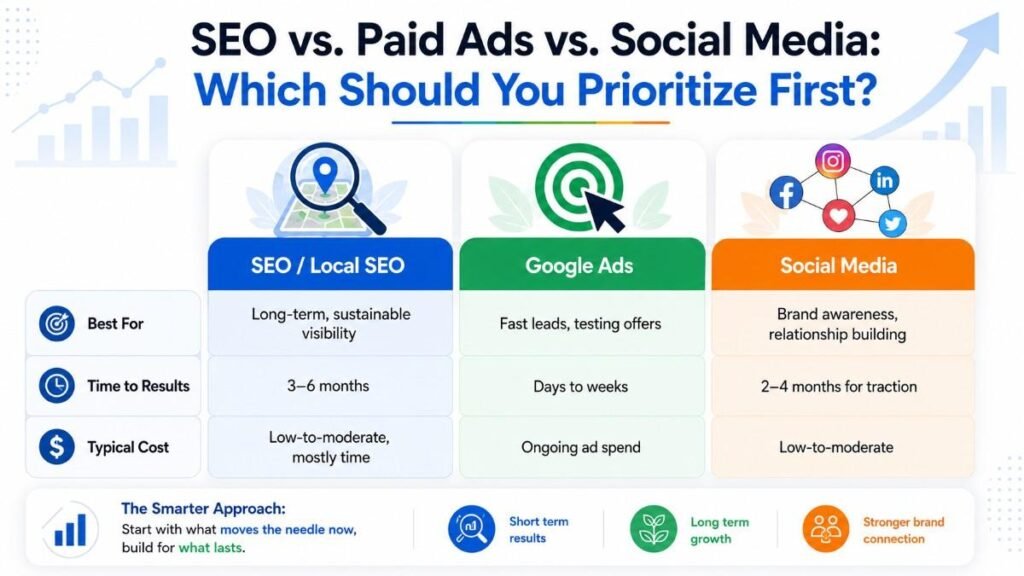
| Channel | Best For | Time to Results | Typical Cost |
| SEO / Local SEO | Long-term, sustainable visibility | 3–6 months | Low-to-moderate, mostly time |
| Google Ads | Fast leads, testing offers | Days to weeks | Ongoing ad spend |
| Social Media | Brand awareness, relationship building | 2–4 months for traction | Low-to-moderate |
In my experience, businesses with a limited budget usually get the best long-term return by prioritizing SEO and Google Business Profile first, then layering in ads once the foundation can actually convert that traffic.
FAQs
The cost of a Digital Marketing Strategy for a small business can vary a lot. It really depends on what you want to achieve and the channels you use. If you do it yourself the only cost is your time.. If you work with a freelancer or an agency the cost can be very different depending on what you need. The important thing is to make sure you are spending your money on things that will really help your business and that you can measure the results.
It is also good to know how long it takes to see results from your Digital Marketing Strategy . If you are working on your websites search engine optimization or your Google Business Profile it can take around three to six months to see results.. If you use paid ads you can get leads in just a few days. However paid ads usually cost more for each lead until you have a website and know who your target audience is.
You do not need an agency to create a Digital Marketing Strategy . You can definitely do some things on your own like checking your website and Google Business Profile to see what needs to be improved and planning some content.. For more complicated tasks, like advanced search engine optimization or managing ad campaigns it can be helpful to get expert help.
So what is the first step in creating a Digital Marketing Strategy for your small business? You should always start by looking at your website Google Business Profile and social media presence. This is like taking a snapshot of where you’re now. You cannot create a strategy if you do not know where you are starting from. A digital marketing strategy for a business is all, about figuring out what you need to do to achieve your goals and taking it one step at a time.
Final Thoughts
A solid digital marketing strategy for small business doesn’t require a huge budget or a dozen marketing channels running at once. It requires a clear sequence — audit, goals, audience, local SEO, on-page fixes, content, and (when ready) paid ads — executed consistently and measured honestly. That’s the same process I use with clients across local, e-commerce, and service-based businesses, and it’s the one I’d recommend starting with, regardless of your industry.